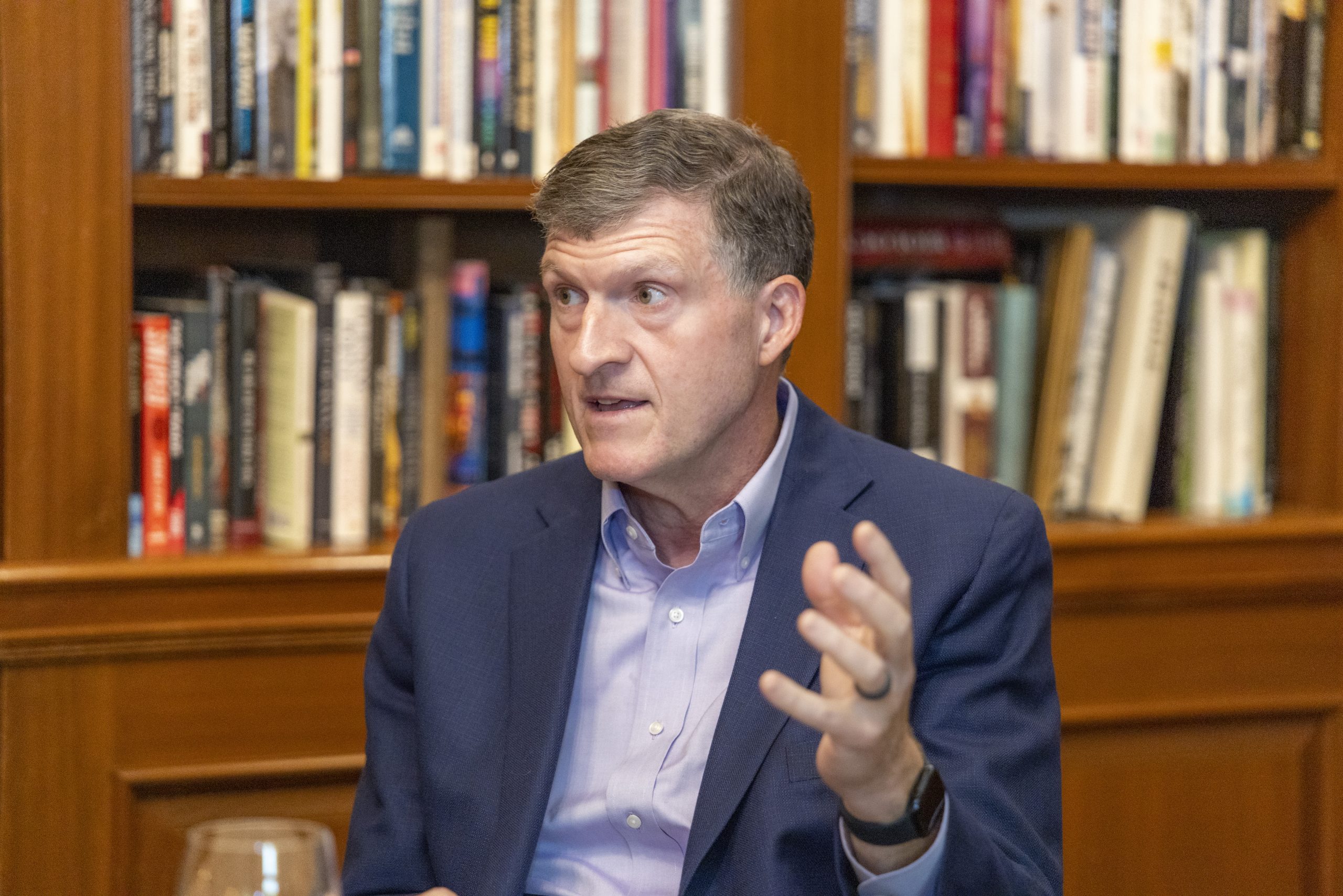
| Operating Advisor |  Bessemer Venture Partners Bessemer Venture Partners | 2025-10-01 – Present | S. Clinton Hinote is an operating advisor for Bessemer Venture Partners specializing in organizational reinvention and strategic leadership in defense tech. |  Bessemer Venture Partners Google KGMID Bessemer Venture Partners Google KGMID |
| Executive Chair of Federal and Defense Initiatives |  LIS Technologies Inc. LIS Technologies Inc. | 2025-09-11 – Present | S. Clinton Hinote serves as Executive Chair of Federal and Defense Initiatives for LSI Technologies Inc. and assists in the development and implementation of a strategic planning framework that aligns the company's initiatives with military, defense, and government policies, ensuring consistency with federal priorities and national security goals. | |
| Professor of Policy Analysis |  RAND School of Public Policy RAND School of Public Policy | 2024-01-01 – Present | Lt. Gen. S. Clinton Hinote is a professor of policy analysis at the RAND School of Public Policy. He served as the deputy chief of staff, Strategy, Integration, and Requirements, Headquarters, United States Air Force, at the Pentagon in Arlington, Virginia. In this role, he served as the HAF A5/7, or senior Air Force leader responsible for representing the voice of tomorrow’s Airmen. HAF A5/7, known as Air Force Futures, focuses on developing Air Force strategy and concepts, conducting strategic assessments of the operating environment through wargames and workshops, manifesting an integrated future force design, and achieving timely and effective operational capabilities required for tomorrow’s Airmen to fight and win. | RAND School of Public Policy Google KGMID |
| Principal |  Pallas Advisors Pallas Advisors | 2023-10-01 – Present | Pallas Advisors is pleased to announce that Lt. Gen. (Ret.) Clinton Hinote will be joining the firm as a Principal following his distinguished career spanning over 30 years in the United States Air Force. Sally Donnelly, a founding partner of Pallas, said Clint’s experience pushing for disruptive changes in the Air Force and wider Department writ large is exactly the type of leader we are looking for to join our Team.
Hinote notes that disruption is key to the U.S. staying ahead of our adversaries; investing in future capabilities is more important than ever before. He looks forward to joining Pallas, a team that pushes emerging technology solutions into the right hands within the national security ecosystem. | |
| Expert Advisor |  Special Competitive Studies Project (SCSP) Special Competitive Studies Project (SCSP) | 2023-10-01 – Present | Member of SCSP Defense Panel advising on strategic competition with China, defense policy, and emerging technology; co-authored major reports on uncrewed systems and future warfare. | Special Competitive Studies Project (SCSP) Google KGMID |
| Field Expert |  Dcode Dcode | 2023-08-01 – Present | Field expert advising companies and leaders. | Dcode Google KGMID |
| Principal Owner |  Hinote Strategy LLC Hinote Strategy LLC | 2023-07-01 – Present | Independent consulting focused on matching emerging technology to defense needs, organizational transformation, and executive coaching | |
| Commissioner |  Atlantic Council Commission on Software-Defined Warfare Atlantic Council Commission on Software-Defined Warfare | 2023-03-01 – 2025-03-27 | The Atlantic Council Commission on Software-Defined Warfare presents a software-defined warfare approach, offering recommendations for the DoD to adopt modern software practices and seamlessly integrate them into existing platforms to enhance and strengthen defense strategies. | Atlantic Council Commission on Software-Defined Warfare Google KGMID |
| Deputy Chief of Staff for Strategy, Requirements & Integration (Senior Vice President for Strategy) |  Headquarters U.S. Air Force, The Pentagon Headquarters U.S. Air Force, The Pentagon | 2020-06-01 – 2023-06-01 | Lt. Gen. S. Clinton Hinote is the Deputy Chief of Staff for Strategy, Integration and Requirements, Headquarters U.S. Air Force, the Pentagon, Arlington, Virginia. In this position, Lt. Gen. Hinote is responsible for developing the Air Force strategy and multi-domain operating concepts, integrating through centralized design, and validating (and prioritizing) operational capabilities-based requirements to achieve national defense objectives and deliver timely and effective capability to the warfighter. | Headquarters U.S. Air Force, The Pentagon Google KGMID |
| Deputy Executive Director, Air Force Warfighting Integration Capability, Deputy Chief of Staff for Strategic Plans and Requirements | Headquarters U.S. Air Force, The Pentagon | 2018-03-01 – 2020-06-01 | | Headquarters U.S. Air Force, The Pentagon Google KGMID |
| Deputy Executive Director, Security Cooperation |  U.S. Department of State, U.S. Embassy Baghdad U.S. Department of State, U.S. Embassy Baghdad | 2017-03-01 – 2018-03-01 | As part of the U.S. Mission and U.S. Central Command, the Office of Security Cooperation-Iraq conducts Security Cooperation and Security Assistance to ensure the enduring strategic partnership between the U.S. Military and the Government of Iraq's Security Forces. | U.S. Department of State, U.S. Embassy Baghdad Google KGMID |
| Military Assistant to the Deputy Secretary of Defense |  Office of the Secretary of Defense Office of the Secretary of Defense | 2015-05-01 – 2017-02-01 | Assists the Department of Defense's #2 official and chief operating officer in his leadership duties, including overseeing the department’s annual budget and its over three million civilian and military personnel; interfacing with the Congress, other government agencies, and the media; and developing long term strategies and supporting plans for the department. | Office of the Secretary of Defense Google KGMID |
| Military Fellow |  Council on Foreign Relations Council on Foreign Relations | 2014-07-01 – 2015-05-01 | Offers military expertise in support of the Council's David Rockefeller Studies Program—CFR's think tank—which is home to more than seventy full-time, adjunct, and visiting scholars and practitioners (called fellows). Their expertise covers the major regions and significant issues shaping today's global agenda. CFR fellows contribute to the foreign policy debate by writing books, reports, articles, op-eds, and blogs as well as by holding discussions on the most important challenges facing the United States and the world. | Council on Foreign Relations Google KGMID |
| Commander, 8th Fighter Wing (Vice President, Overseas Region) | United States Air Force, Kunsan Air Base, Republic of Korea | 2013-05-01 – 2014-05-01 | Led the 8th Fighter Wing at Kunsan Air Base, Korea, and also acted as the U.S. Forces Korea Area VI Commander. Responsible for the protection, wellbeing, and mission accomplishment of more than 3100 U.S. and Korean personnel. | United States Air Force, Kunsan Air Base, Republic of Korea Google KGMID |
| Deputy Director, Directorate of Requirements (A8) | United States Air Force, Air Combat Command, Langley AFB | 2012-07-01 – 2013-03-01 | Deputy Director, Directorate of Requirements (A8) for Air Combat Command, Langley AFB | United States Air Force, Air Combat Command, Langley AFB Google KGMID |
| Vice Commander, 52nd Fighter Wing (Assistant Vice President, Overseas Region) | United States Air Force, Spangdahlem Air Base, Germany | 2010-04-01 – 2011-07-01 | Vice Commander, 52nd Fighter Wing (Assistant Vice President, Overseas Region) for Spangdahlem Air Base, Germany | United States Air Force, Spangdahlem Air Base, Germany Google KGMID |
| Commander, 3rd Fighter Training Squadron |  United States Air Force, Vance AFB United States Air Force, Vance AFB | 2009-07-01 – 2010-04-01 | | United States Air Force, Vance AFB Google KGMID |
| Aide-de-Camp to the Commander, Air Education and Training Command | United States Air Force, Randolf AFB | 2008-07-01 – 2009-06-01 | | United States Air Force, Randolf AFB Google KGMID |
| Special Assistant to the Commander |  The Curtis E. Lemay Center, Maxwell AFB The Curtis E. Lemay Center, Maxwell AFB | 2007-08-01 – 2008-06-01 | | The Curtis E. Lemay Center, Maxwell AFB Google KGMID |
| Chief, Strategy Division | Combined Air Operations Center, U.S. Air Forces Central, Al Udeid Air Base, Qatar | 2006-07-01 – 2007-08-01 | | Combined Air Operations Center, U.S. Air Forces Central, Al Udeid Air Base, Qatar Google KGMID |
| Student | School of Advanced Air and Space Studies, Maxwell AFB | 2005-07-01 – 2006-06-01 | | School of Advanced Air and Space Studies, Maxwell AFB Google KGMID |
| Student | Air Command and Staff College, Maxwell AFB | 2004-04-01 – 2005-06-01 | | Air Command and Staff College, Maxwell AFB Google KGMID |
| Initial Cadre Member, Instructor Pilot, F-117 Division |  United States Air Force Weapons School, Nellis AFB United States Air Force Weapons School, Nellis AFB | 2003-03-01 – 2004-06-01 | | United States Air Force Weapons School, Nellis AFB Google KGMID |
| F-117A Instructor Pilot, Flight Commander, Wing Chief of Weapons, 49th Fighter Wing |  United States Air Force, Holloman AFB United States Air Force, Holloman AFB | 1999-04-01 – 2003-03-01 | | United States Air Force, Holloman AFB Google KGMID |
| F-16 Flight Lead, Electronic Combat Pilot, Weapons and Tactics Officer, 20th Fighter Wing |  United States Air Force, Shaw AFB United States Air Force, Shaw AFB | 1996-07-01 – 1999-03-01 | | United States Air Force, Shaw AFB Google KGMID |
| Student, F-16 Fighter Training Unit |  United States Air Force, Luke AFB United States Air Force, Luke AFB | 1995-11-01 – 1996-06-01 | | United States Air Force, Luke AFB Google KGMID |
| Student, Undergraduate Pilot Training |  United States Air Force, Columbus AFB United States Air Force, Columbus AFB | 1994-06-01 – 1995-06-01 | | United States Air Force, Columbus AFB Google KGMID |
| Student |  Air Force Institute of Technology Air Force Institute of Technology | 1992-08-01 – 1994-06-01 | | Air Force Institute of Technology Google KGMID |
| Student |  John F. Kennedy School of Government, Harvard University John F. Kennedy School of Government, Harvard University | 1992-08-01 – 1994-06-01 | | John F. Kennedy School of Government, Harvard University Google KGMID |